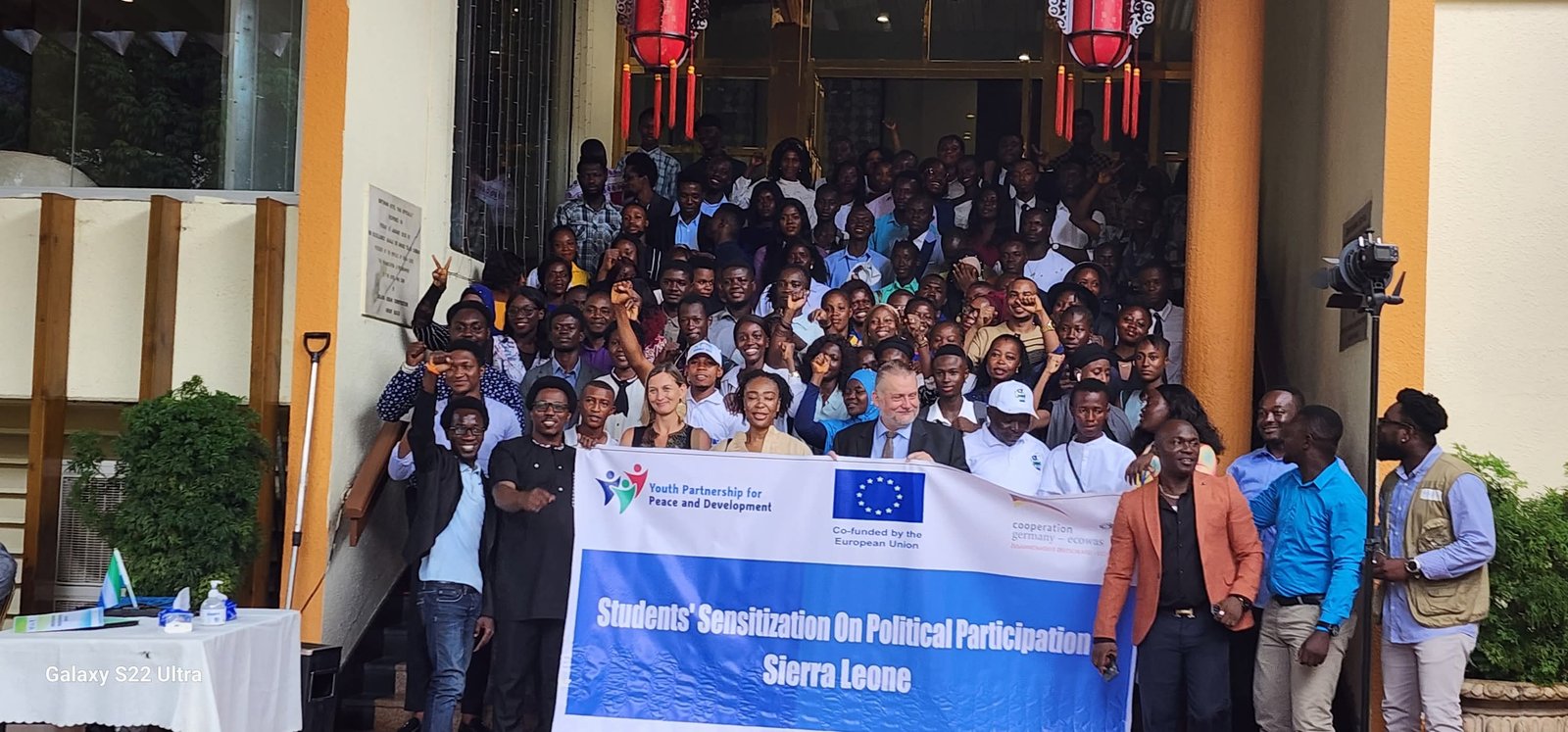
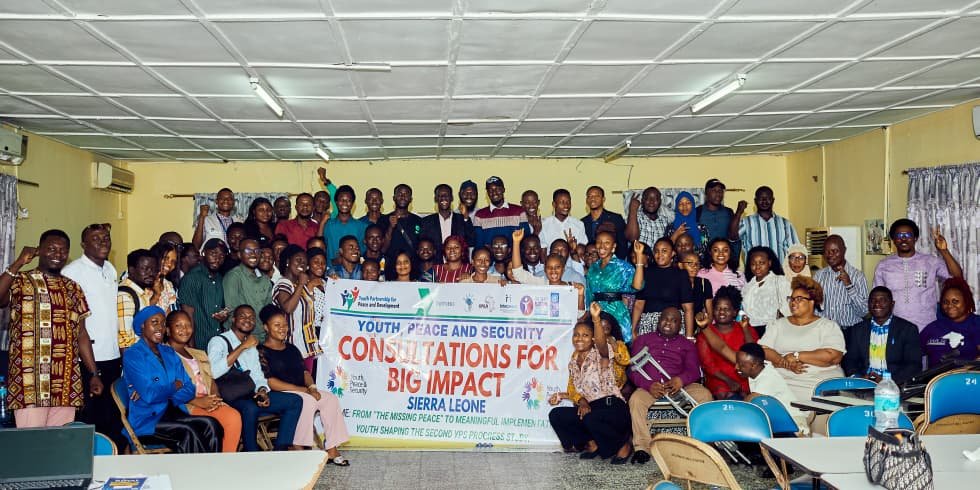
Ten years after the adoption of United Nations Security Council Resolution 2250 (UNSCR 2250), young people from across Sierra Leone have delivered a clear message: meaningful youth participation must go beyond consultation. Young people must be empowered as partners and co-leaders in the decisions that shape peace, security and national development. This message emerged strongly from the Sierra Leone National Youth Consultation on Youth, Peace and Security (YPS), held on 27 January 2026 at the Civil Service Training College in Freetown.
Convened by the Youth Partnership for Peace and Development (YPPD) in partnership with the African Women Leaders Network (AWLN), WANEP Sierra Leone and the National YPS Coalition, with support from Interpeace and the Civil Society Platform for Peacebuilding and Statebuilding (CSPPS), the consultation brought together 120 participants representing all 16 districts of Sierra Leone.
The national consultation formed part of the global YPS Consultations for Big Impact initiative and contributed Sierra Leonean youth perspectives to the Second Independent Progress Study on Youth, Peace and Security, marking ten years since UNSCR 2250 established the global Youth, Peace and Security agenda.
From Three Districts to a National Conversation
The consultation was initially planned to take place across three districts. Recognizing the importance of capturing a broader range of experiences and ensuring national representation, the process was expanded into a national dialogue.
Youth leaders, representatives of youth-led and civil society organizations, government stakeholders and peacebuilding practitioners came together from across Sierra Leone. Efforts were made to ensure gender balance and the inclusion of young women and young people from underserved communities. Through focus group discussions, thematic presentations, plenary sessions and collective validation, participants reflected on Sierra Leone's progress since the adoption of UNSCR 2250 in 2015.
They also confronted a fundamental question: How can Sierra Leone move from recognizing young people as important peacebuilding actors to giving them meaningful influence over the decisions that affect their lives?
Progress Has Been Made—but Participation Must Become Meaningful
The consultation found that Sierra Leone has made important progress over the past decade. Youth issues have become more visible in national policy discussions. Civic engagement opportunities have expanded. Youth-led organizations and coalitions are increasingly coordinating advocacy and engaging government and development partners. Young people are also playing active roles in mediation, civic education, community dialogue and local peacebuilding.
Yet participants stressed that recognition does not always translate into influence.
Young people may be invited to consultations and policy dialogues but are still too often excluded from the stages where final decisions are made.
As one youth participant, Esther, powerfully observed:
“Consulting us after decisions are made is not participation, it is tokenism.”
The consultation therefore called for a transition from symbolic participation toward institutionalized youth representation and genuine co-leadership.
This means creating permanent mechanisms through which young people can participate in policy design, implementation and monitoring at both national and local levels—not simply inviting them into temporary, project-based consultations.
Youth Are Already Preventing Conflict in Their Communities
One of the strongest findings was that young people are not waiting to be formally recognized before contributing to peace.
Across communities, youth are already mediating disputes, promoting civic awareness, supporting social cohesion and functioning as informal early-warning actors.
However, many of these efforts receive little institutional recognition or sustainable financial support.
As Saidu Bangura, Community Education and Training Officer at YPPD Sierra Leone, explained:
“Youth are already preventing conflicts in communities, but without recognition or resources.”
Participants called for stronger decentralized peace dialogue platforms and the formal integration of young people into conflict-prevention and early-warning mechanisms.
The message is significant: investing in youth peacebuilding should not be understood simply as creating something new. In many communities, it means recognizing, strengthening and adequately resourcing work that young people are already doing.
Economic Exclusion Is a Peace and Security Issue
Peace, participants emphasized, cannot be understood only as the absence of violence.
Young people described peace as encompassing inclusive governance, economic opportunity, social justice and community cohesion. Security was similarly understood to include access to livelihoods and equitable services.
This broader understanding reflects one of the consultation's most consistent findings: economic insecurity, unemployment and inequality are major peace and security concerns for young people.
Limited livelihood opportunities were repeatedly linked to frustration, social tension, crime, vulnerability and migration pressures.
For marginalized young people, sustainable reintegration also requires more than returning to communities. Participants emphasized the importance of employment, psychosocial support, reconciliation and opportunities to rebuild their lives.
As Tejan Kellah, President of the National Youth Council, stated:
“Without opportunities, reintegration becomes survival, not recovery.”
Young Women Continue to Face Unequal Barriers
The consultation also highlighted the particular barriers confronting young women.
Despite increasing awareness of gender inclusion, participants reported that cultural norms, political barriers, intimidation, limited resources and restricted access to leadership opportunities continue to prevent many young women from participating equally in governance and peacebuilding.
This means that increasing youth participation alone is not enough. Participation must also be safe, equitable and inclusive.
As participant Bintu Aruna emphasized:
“Participation must also mean protection, young people need safe spaces to speak, organize and take action.”
The findings call for gender-responsive safeguards, stronger protection mechanisms and deliberate investment in young women's leadership.
Climate Change Is Emerging as a Peacebuilding Challenge
Another important message from the consultation was the growing connection young people see between climate change, livelihoods and peace.
Environmental degradation and climate shocks were identified as emerging security threats, particularly where communities depend heavily on natural resources and climate-sensitive livelihoods.
For young people, climate change is therefore not an isolated environmental concern. When environmental pressures undermine livelihoods, increase competition over resources or deepen existing inequalities, they can also threaten community stability.
The consultation recommends integrating climate resilience and economic empowerment into Youth, Peace and Security programming, recognizing the interconnected nature of development and sustainable peace.
Five Pillars, One Consistent Message
Discussions were structured around the five pillars of the Youth, Peace and Security agenda: Participation, Prevention, Protection, Partnerships, and Disengagement and Reintegration.
Across these pillars, several cross-cutting concerns repeatedly emerged:
- Young women continue to face structural and cultural barriers to leadership.
- Economic insecurity and unemployment remain major drivers of instability.
- Climate change and environmental degradation increasingly affect livelihoods and community stability.
- Rural youth and persons with disabilities face disproportionate exclusion from governance and development opportunities.
- Digital platforms offer new opportunities for youth participation while also creating risks related to misinformation and exclusion.
- Youth-led organizations remain significantly under-resourced despite their proximity to communities and their role in conflict prevention.
Together, these findings show that Youth, Peace and Security cannot be addressed through isolated projects. Meaningful progress requires changes in governance, financing, economic opportunity, protection and institutional relationships.
Government Leadership and the Road Toward a National Action Plan
The consultation also provided an important opportunity for dialogue between young people and government.
The keynote address was delivered by Hon. Chernoh Bah, Minister of Information and Civic Education, who reflected on his participation as a youth advocate at the 2015 Amman Conference connected to the emergence of the Youth, Peace and Security agenda.
His reflections emphasized the need to move from commitments to measurable outcomes, strengthen civic education and recognize young people as drivers of innovation, social cohesion and democratic accountability.
The Ministry of Youth Affairs also reaffirmed the Government's commitment to advancing the YPS agenda and highlighted ongoing collaboration with the United Nations Development Programme toward developing a National Action Plan on Youth, Peace and Security.
The consultation strongly recommends that Sierra Leone prioritize the development, adoption and adequate resourcing of this National Action Plan so that UNSCR 2250 and related commitments can be translated into an institutional framework for action.
Partnerships Must Mean Shared Power
Youth coalitions and networks were identified as one of the positive developments of the past decade. Platforms such as the National YPS Coalition are strengthening coordination, collective advocacy and engagement among youth organizations, government institutions, civil society and development partners.
Yet participants stressed that partnerships must go beyond occasional engagement.
As Valnora Edwin, Coordinator at AWLN and Co-Convener of the consultation, stated:
“Partnership means shared power, not occasional consultation.”
For development partners, this also means reconsidering how youth-led organizations are financed. The consultation calls for sustained and flexible support that moves beyond short project cycles and invests directly in youth leadership, institutional capacity, research and locally led peacebuilding.
A Call to Action for the Next Decade
The Sierra Leone National Youth Consultation makes clear that the country has made meaningful progress since the adoption of UNSCR 2250.
But the next decade requires something more ambitious.
Government should institutionalize youth participation and resource a National Action Plan on Youth, Peace and Security. Development partners should provide more sustainable and flexible financing directly to youth-led peacebuilding initiatives. Civil society and youth coalitions should continue strengthening coordination, mentorship, evidence generation and collective advocacy.
Above all, young people must have meaningful opportunities to influence decisions from the beginning—not simply be consulted after priorities have already been determined.
Sierra Leone's young people are already mediators, organizers, advocates, civic educators, innovators and community peacebuilders. They are producing knowledge about the challenges affecting their communities and developing solutions grounded in lived experience.
The challenge for the next decade of Youth, Peace and Security is therefore not simply to recognize young people's potential.
It is to share power, provide resources, create permanent pathways for participation and enable young people to co-lead.
As Sierra Leone advances its peacebuilding journey and contributes to the global Second Independent Progress Study on Youth, Peace and Security, the message from the national consultation could not be clearer:
Sustainable peace must be built with young people—not merely for them.
This article is based on the Sierra Leone National Youth Consultation Report: Contribution to the Second Independent Progress Study on Youth, Peace and Security (UNSCR 2250 at 10), documenting the National Youth Consultation held in Freetown on 27 January 2026.